
LLM Evaluation Metrics: How to Measure Accuracy, Safety, and Cost

Introduction

LLMs, also known as ‘large language models’, are widely used for different tasks, including customer support, content creation, coding, research, data analysis, and automation of business processes. Yet selecting the right LLM based on its ability to respond fluently is insufficient; businesses require dependable means to estimate their accuracy, safety, efficiency, and affordability. And here come the LLM evaluation metrics.

The process of LLM evaluation implies the assessment of its performance on the basis of certain criteria and application scenarios. Although the list of metrics may differ depending on the field, there are three aspects that should be considered.

Measuring LLM Accuracy

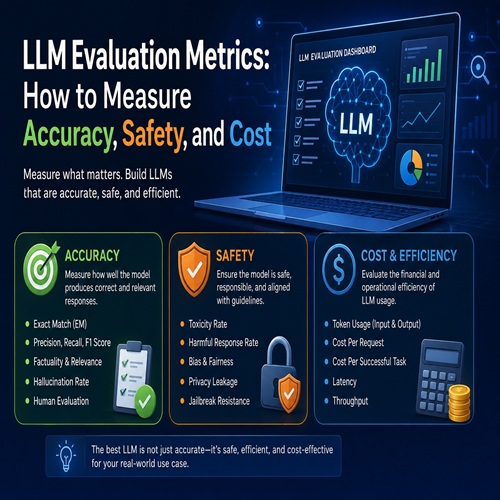
Accuracy defines the performance of an LLM in producing relevant and useful responses. Accuracy measurements may fit traditional task definitions well. However, the evaluation of generative AI requires a more comprehensive approach.

Exact match (EM) checks if the response of an AI system matches the expected answer literally. While the metric may be useful for a structured problem, it is not suitable for more complicated tasks.

The precision, recall, and F1 score metrics are applicable to evaluate classification models, information extraction systems, or question-answering models. While precision refers to the proportion of relevant results among the retrieved ones, recall shows what percentage of relevant results the system can find.

For generative answers, businesses can also consider relevance, factuality, and semantic similarity metrics. In addition to that, the assessment performed by humans helps to understand if an answer really addresses the user’s question.

One more critical factor to measure is a hallucination rate. While an LLM may provide information which is very convincing from the point of view of its language, it may not be factually correct. This metric is especially important for finance, healthcare, law, or business applications.

Measuring LLM Safety

Accuracy alone cannot serve as a sufficient condition for a model’s readiness for production since even if the LLM presents accurate information, it may generate harmful, biased, offensive, or inappropriate output at the same time.

Safety assessment can be utilised to evaluate the model’s capability to reject harmful queries, resist unsafe prompts, protect sensitive data, and preserve appropriate behaviour in adversarial situations.

Toxicity, harmful response rate, bias, privacy, and vulnerability to jailbreaking are some of the important aspects of safety assessment. Not only usual prompts from users but also adversarial examples need to be evaluated for safety.

Human assessment can also be employed to measure responses according to safety guidelines. Combining automation with human safety assessment usually allows for obtaining a more holistic picture of the model’s safety.

Measuring LLM Cost and Efficiency

However, the most sophisticated models are not necessarily the most economic ones. In case companies are processing thousands or millions of requests, slight changes in the usage cost may make a huge impact on the total budget of AI.

Among the key performance indicators, there is token usage. Providers of large language models usually count the cost per input and output tokens. Measuring tokens per request will help to understand how effectively the application uses the model.

Other KPIs can be cost per request, cost per completed task, latency, throughput, and infrastructure utilisation. The model that has a slightly higher cost per request but solves the tasks effectively will bring more value than the inexpensive one that needs multiple iterations of prompts or human support.

In other words, businesses should estimate the cost in regard to performance.

Building a Balanced LLM Evaluation Framework

Accuracy, safety, and cost must be incorporated into an effective evaluation system, as opposed to being separate metrics. By understanding the differences between LLM and ChatGPT models, businesses can develop a benchmark dataset that has representative real-world prompts and use it to test multiple models.

A potential scoring mechanism would entail assessing accuracy, relevance, hallucinations, safety violations, number of tokens used, latency, and cost for a successful output. These measures can be tracked constantly since model performance may change over time based on new prompts, datasets, models, and applications.

Conclusion

Evaluation methods for LLMs give a systematic way of assessing the appropriateness of an AI model for a specific business use case. The accuracy of a model ensures reliable performance, safety metrics keep risks minimal, and cost and efficiency metrics help limit the cost of operations.


Thus, it is not true that the best LLM will always be the one with the highest benchmark score. The best LLM will be the one that provides the right balance of accuracy, safety, efficiency, and cost. Through continuous assessment of these parameters, companies will be able to develop better AI models.