
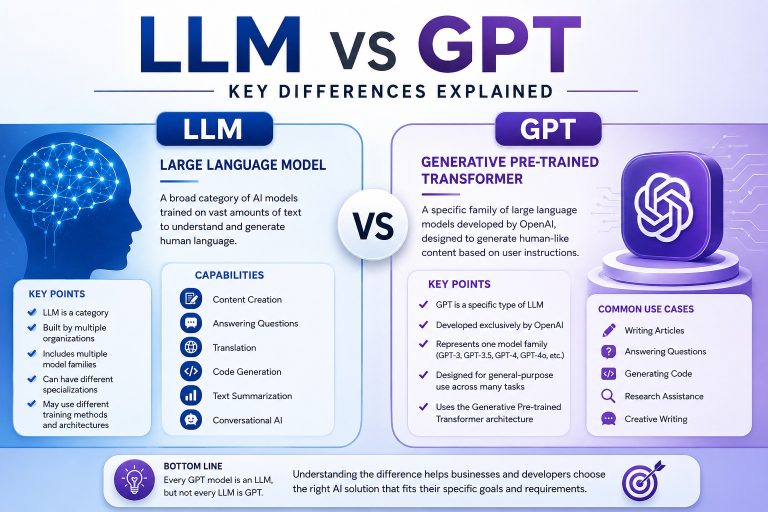
Key Differences Between LLM and GPT

LLM vs GPT
Introduction

Artificial Intelligence (AI) has been explored at high speed during the last few years, and the two terms that are part of discussions about AI-powered language systems are Large Language Models (LLMs) and GPT. While these terms are closely related, they are not interchangeable. Many people believe that LLM and GPT are the same, but there exists a huge difference between both of them. GPT is actually a type of LLM rather than a separate category.

It is therefore necessary for businesses, developers, and technosavvy people to understand their differences and make informed decisions when selecting AI solutions for their projects.

What Is an LLM?

A Large Language Model (LLM) is an AI model trained on a huge quantity of text data to understand, process, and generate human language. These models use advanced machine learning techniques to recognize patterns in language and generate relevant responses.

LLMs can perform a wide range of tasks, including:

  • Creation of content
  • Summarizing a text
  • Translating a language
  • Answering questions
  • Analyzing sentiments
  • Generating code for web and application development
  • Conversational AI

Several organizations have developed their own LLMs tailored to their business needs. As a result of this, today LLM has emerged as a broad category that includes numerous language models.

What Is GPT?

GPT stands for Generative Pre-trained Transformer. It consists of large language models developed by OpenAI. GPT models are designed to generate content similar to that written by a human. This content is created on the basis of instructions provided by the user.

With the technical developments, GPT has undergone various updates; today, it is recognized as one of the highly advanced AI technologies due to its ability to perform different types of tasks, including writing articles, answering questions, generating code, and assisting with research.

As GPT is based on large language model technology, it belongs to the LLM category. However, it represents only one implementation within a much larger ecosystem of language models.

Understanding the difference

Difference 1: LLM Is a Category, Whereas GPT Is a Specific Type of LLM

The most important difference between these terms is their scope.

An LLM refers to the vast category of AI language models that are capable of understanding and generating text. GPT, on the other hand, is a specific family of models within that category. This can be understood with a simple example. Where a vehicle is used to define vast categories of vehicles, including two-wheelers, three-wheelers and four-wheelers, whereas a car is defined as a particular type of vehicle. The same rule follows when talking about LLM and GPT. Where there are different models of LLM, GPT represents a type of LLM.

Difference 2: LLMs Can Be Developed by Different Organizations, While GPT Is Developed by OpenAI

Based on their specific needs, large business organization develop their own LLMs to meet specific goals, which can be conversational AI, coding assistance, research, or enterprise applications.

GPT, however, is exclusively developed by OpenAI. All versions of GPT have been developed from the same development team and follow a fixed technical format.

Difference 3: LLM Refers to Multiple Model Families, While GPT Refers to One Model Family

The term LLM consists of multiple model families available in the AI landscape. Each family may have its own training methodology, strengths, and intended use cases.

GPT represents a single model family that has grown through several generations. Although the capabilities of GPT have improved over time, it remains one branch within the broader LLM ecosystem.

Difference 4: LLMs May Have Different Specializations, While GPT Is Designed for General-Purpose Use

LLM models can be developed according to the organizational needs of businesses. Some LLMs are optimized for coding tasks, whereas others are used for communication in multiple languages, assisting in research tasks or enterprise applications. The method to train and fine-tune them may differ and be based on the task for which they are developed.

GPT is primarily designed as a general-purpose AI system that is capable of performing a wide range of tasks. This ability has made it one of the most highly used AI technologies by all sectors.

Difference 5: LLMs Can Use Different Training Methods, While GPT Uses the Generative Pre-trained Transformer Architecture

The term LLM is used to define the size and capability of a language model instead of defining it as a single architecture.

Different LLMs may involve unique training techniques, optimization strategies, and model designs. GPT, on the other hand, specifically depends on the Generative Pre-trained Transformer architecture, which enables it to understand context and generate coherent responses.

Why It Is Important To Understand The Difference Between Two:

With the increasing use of AI in every industry, businesses have started comparing various language models for customer support, content generation, software development, and business automation.

Understanding the difference between LLM and GPT helps organizations in focusing on their specific requirements and moving ahead in the right direction. This knowledge enables better comparisons between available models and helps decision-makers choose the most suitable technology for their needs

Conclusion

Although LLM and GPT are closely related to each other, they are used for different reasons. A large language model is a vast category of AI systems designed to understand and generate human language, while GPT is a specific family of language models developed by OpenAI.

In simple terms, every GPT model is an LLM, but not every LLM is GPT. Recognizing this difference helps in understanding the rapidly changing AI landscape and helps users to understand the growing number of language models available today.