
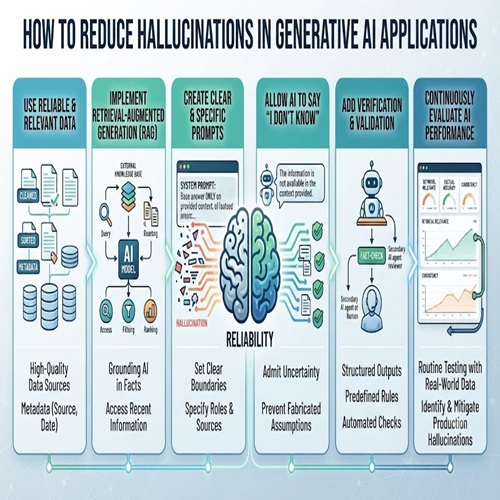
How to Reduce Hallucinations in Generative AI Applications

Introduction

Generative AI applications are increasingly becoming a significant component of customer support, content creation, business automation, research and decision-making. Yet there is one major problem: AI hallucination, which occurs when an AI system produces information that is incorrect, not supported by evidence or entirely made up. Because such responses can seem believable, hallucinations can damage user trust and have an impact on business results.

Even though hallucinations cannot be entirely eliminated, businesses can greatly cut them down by using reliable data, improving their prompts and retrieval systems, carrying out validation, and carrying out continuous evaluation.

Use Reliable and Relevant Data

The quality of the information given to an AI program has a direct impact on the quality of the responses it gives; if the data is outdated, incomplete or inaccurate, the model will produce misleading answers.

People ought to make use of reliable and up-to-date data sources. The documents should be cleaned, sorted, and divided up into clear sections in order that the relevant information may be retrieved easily. Further assistance to applications in identifying the most suitable information can be provided by metadata, including source, date, and category.

Implement Retrieval-Augmented Generation

Retrieval-Augmented Generation (RAG) is one of the most effective methods for reducing hallucinations; rather than depending completely on the information acquired during the training of the model, a RAG application obtains relevant information from an external knowledge base and then gives it to the model before the response is generated. 

For instance, a customer-service chatbot can get access to the most recent product documentation prior to responding to a customer’s query. This provides the model with some factual information and decreases the need to depend on possibly out-of-date internal knowledge. 

RAG only proves effective if the retrieval process is accurate; inadequate document chunking, irrelevant search results or missing information can still cause wrong responses. It is therefore important to improve the search, the embedding’s, the filtering and the re-ranking.

Create Clear and Specific Prompts

Prompt engineering can likewise be used to help control hallucinations; rather than just asking an AI model to give an answer, developers can set clear boundaries. For instance, a prompt can tell the model to base its answer only on the information provided and to make it clear when the information available is not sufficient. This prevents the system from filling in knowledge gaps with assumptions.

It is also necessary to specify the application’s role, the sources it is allowed to use, and the format in which it should produce its response. Detailed instructions are especially helpful once the underlying retrieval and data systems have been properly designed.

Allow the AI to Say "I Don't Know"

A frequent cause of hallucinations is the assumption that an AI system should always give an answer; it is better to let the model admit when it is uncertain. The application should state that the information is not available if the retrieved information does not include an answer rather than coming up with a response. Such a straightforward approach can greatly enhance reliability, especially in the case of enterprise applications which deal with particular or sensitive information.

Add Verification and Validation

It is not necessary in all cases to give AI-generated responses directly to users; instead, a separate verification step can be used to check if the claims in the generated response are supported by the information retrieved. Applications may also make use of structured outputs, predefined rules and automated checks in order to detect information that is not supported. In the case of critical applications, a response can be examined by either another AI system or a human before an action is carried out.

Continuously Evaluate AI Performance

Getting rid of hallucinations is not something you can accomplish once and for all, but something that has to be continuously carried out. Developers should routinely test applications with real-world questions and specific test cases. Evaluation should include the assessment of various factors such as retrieval relevance, completeness, factual accuracy and the fact that the responses stay consistent with the given context. Production hallucinations should also be included in the test datasets so that future updates to the system do not make the same mistakes.

Conclusion

It takes more than just drafting a better prompt to reduce hallucinations in generative AI applications. Businesses should adopt a multi-layered strategy which involves the use of high-quality data, RAG, clear instructions, uncertainty management, verification, and continuous evaluation. By implementing such safeguards, organisations can make their generative AI applications more accurate, reliable and trustworthy at the same time as lowering the risks linked to AI-generated information that is not supported.