
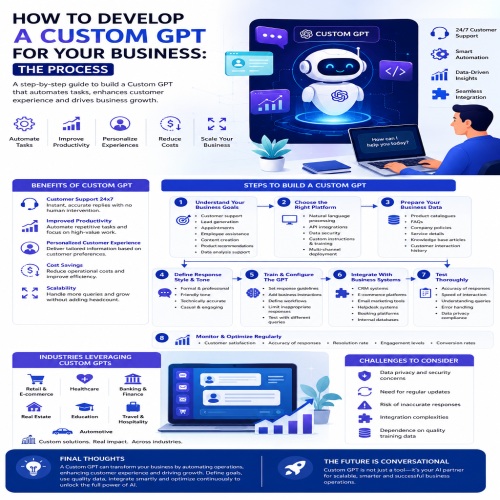
How To Develop A Custom GPT For Your Business: The Process

Introduction

The adoption of Artificial Intelligence (AI) has become a necessity of time for businesses in the current scenario. Initiating AI in any business changes the process of its operations, the method of communicating with clients and providing services to customers. The use of customized GPT is one of the most recognizable innovations in AI, which has dynamically changed the way businesses work. A custom GPT (Generative Pre-trained Transformer) is an AI-powered platform developed to perform a wide range of business operations according to its nature.

Some of the tasks that can be performed smoothly by using this platform are providing customer support, assisting customers in making tailored decisions, creating promotional content and managing business operations smoothly without human interventions. 

Going through the benefits enjoyed by businesses deploying customized GPT in their workflow, today, they have become an integral part of every business. With its help, businesses can automate the tasks that are repetitive in nature, provide a personalized experience to customers and enhance their productivity. The use of this platform not only helps businesses stay competitive in their segment but also enhances their productivity and efficiency.

Personalized Services to Customers:

These GPTs are capable of providing personalized information to customers, matching their interests and preferences. Doing this helps in satisfying customers and increasing their engagement with the business. 

Understanding Custom GPT?

A custom GPT, as the name suggests, is a customized version of an AI chatbot. It can perform all those tasks easily and quickly that benefit your business. As compared to traditional chatbots, they are trained with specific information that is relevant to a particular business, its working process and the way it interacts with its customers. 

This can be understood by comparing a chatbot of an e-commerce company and a healthcare provider. Where the chatbot of the former will contain information related to products it sells, the latter will be used for scheduling appointments with patients, and their health data, etc. 

Benefits of Building a Custom GPT

Personalized Services to Customers:

A customized GPT is capable of replying to customer queries 24×7 without any mistakes. It is efficient in providing quick replies to customers, helps in rectifying common issues and reduces the work pressure from employees. 

Improved Productivity:

There are many tasks in businesses that are necessary to perform daily for smooth operations. These tasks are time-consuming but are necessary to perform without any interruption. By deploying a custom GPT, businesses can automate these tasks and allow their employees to concentrate on tasks that are creative and productive. 

4. Automated Manipulation of Public Opinion
  • AI-driven bots amplifying specific political or social messages
  • Targeted misinformation campaigns using behavioral data
  • Suppression or distortion of opposing viewpoints
  • Undermining democratic processes and public discourse

Impact of AI Misuse:

  • Loss of trust in digital media
  • Threats to democratic institutions
  • Financial, reputational, and psychological harm
  • Increased difficulty in distinguishing authentic content

Addressing misuse requires both technical safeguards and ethical accountability.

Privacy and Data Protection

AI systems rely heavily on data, often including personal or sensitive information. This creates significant concerns around data privacy, consent, and security.

Key Privacy Risks:

  • Excessive or unnecessary data collection
  • Lack of transparency in data usage
  • Unauthorized data sharing or breaches
  • AI models unintentionally retaining sensitive information

Responsible Privacy Practices Include:

  • Clear user consent and data transparency
  • Data minimization and anonymization
  • Secure storage, encryption, and access controls
  • Compliance with data protection regulations such as GDPR

Without strong privacy safeguards, AI systems risk eroding user trust and violating fundamental rights.

Bias and Fairness in AI

The Need for AI Regulation

AI development is advancing faster than existing legal and regulatory frameworks. Without clear rules and accountability, the risk of harm increases significantly.

Why Regulation Is Essential:

  • To protect individuals from harmful or unfair AI decisions
  • To ensure transparency and accountability
  • To prevent misuse and unethical deployment
  • To build public confidence in AI technologies

Effective AI Regulation Should Focus On:

  • Transparency and explainability of AI systems
  • Clear responsibility and liability structures
  • Risk-based classification of AI applications
  • Protection of privacy and human rights
  • International cooperation and standards

Regulation should support innovation while ensuring AI is deployed responsibly and safely.

Why Choose Dotsquares

Dotsquares is committed to building AI solutions that are:

  • Fair and unbiased
  • Transparent and explainable
  • Secure and privacy-compliant
  • Resilient against misuse
  • Aligned with regulatory and ethical standards

By choosing Dotsquares, organizations don’t just adopt AI, they adopt responsible, trustworthy, and future-ready intelligence.

Conclusion

The future of AI depends not only on its technical capabilities, but on how responsibly it is designed and governed. Addressing bias, fairness, privacy, misuse, and regulation is critical to ensuring AI serves society in a safe and ethical manner.

By embedding ethics and safety into AI systems from the outset, organizations can build technologies that are not only powerful, but also trustworthy and sustainable.

Responsible AI is not optional, it is the foundation for long-term innovation and societal trust.