
Artificial intelligence is becoming a part of modern business work, but companies do not always need the biggest and most powerful AI models. Small Language Models, also called SLMs, are gaining attention because they can give focused and cost‑effective AI power for specific business needs. Unlike language models or LLMs Small Language Models are meant to do narrower jobs while using less computing power.
Small Language Models are AI systems built to understand and produce human language. They can be. Fine‑tuned for specific industries, apps or work flows. Their smaller size lets businesses run them on servers, cloud systems or even edge devices. The main benefit is that businesses can pick a Small Language Model that fits the task’s difficulty of using a big model for every job. Small Language Models work well for tasks like classification pulling out information, summarizing, routing and other repetitive jobs.
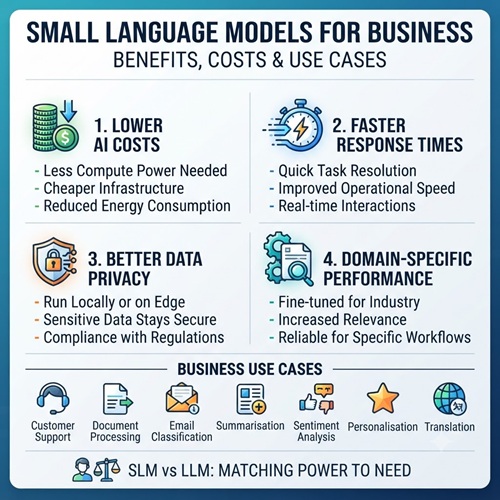
Small Language Models cut down on infrastructure and running costs. Because Small Language Models use less compute power, memory and energy than models they become cheaper for companies that handle many requests. Lower costs let businesses add AI to work, not just to a few high‑value projects.
Small language models can solve tasks quickly because they have fewer numbers and need less resources. This makes them useful when speed matters, like in customer service helpers, live recommendations and operational systems.
Companies that handle data can use Small Language Models in private or secure places. Some Small Language Models run locally or on edge devices sensitive data does not need to leave the company. This helps meet privacy rules, compliance and data‑governance needs.
A small language model can be fine‑tuned for an industry or business process. Of learning everything it focuses on the company’s words, documents and work steps. This increases relevance and reliability for jobs.
SLMs can support a range of business applications including:
Answering common questions and routing tickets to the right team.
Pulling data from invoices, forms, contracts and reports.
Email classification means sorting emails. Sending emails, to the correct department.
Content summarisation means summarising content of meetings, reports and customer chats.
Sentiment analysis means spotting customer feelings in reviews, surveys and social media.
Personalisation means making recommendations and custom messages.
Translation means giving help even on device.
Assistants mean helping staff find company information and finish tasks.
Even though small language models cut AI costs, they are not free. Companies must spend on picking the model, fine‑tuning and preparing data, testing, launching and watching it work. Another drawback is power. Large models are still better for reasoning, open‑ended chats, long‑context review and unpredictable tasks. Picking a small language model for its price can lower output quality. Also, if a company runs open‑weight small language models on its own it must handle hardware, cybersecurity, updates, monitoring and AI governance. These add to the cost.
The decision depends on the job not on the model size. Companies can use Small Language Models for tasks that repeat are predictable and come in numbers and keep large models for deep reasoning and special needs. A mix can work well. A Small Language Model handles requests then sends harder questions to a large model. This routing helps firms balance cost, speed and AI power.
Small Language Models are a choice for companies looking for real and affordable AI. They need power work faster keep data private and can handle special workflows. They do not replace models entirely; instead, small language models fit into a wider multi‑model AI plan, where each task gets the best model. By matching the model’s power with the company’s needs, firms can keep costs down while still getting value from AI.