
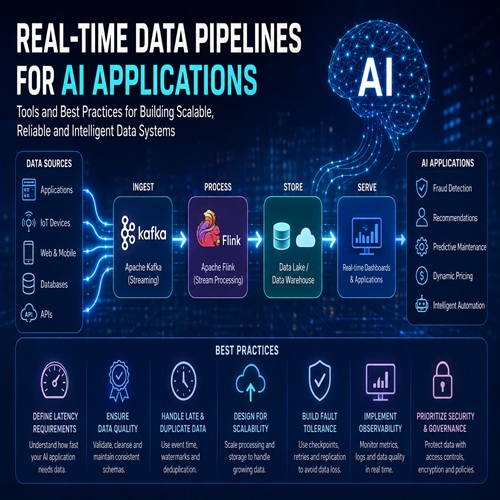
Real-Time Data Pipelines for AI Applications: Tools and Best Practices

Introduction

The use of AI applications is highly increasing on the availability of the data which is timely, correct and available in minimum possible delays. While batch processing is fine for historical analysis, most of the modern AI applications require reacting to events in real time. Real-time data pipelines allow businesses to collect, process and deliver data to AI models, analytics systems and other applications continuously.

Real-time data pipelines are becoming increasingly relevant in various types of modern AI infrastructure applications – be they fraud detection, personalised recommendations, predictive maintenance or intelligent automation. They are also being used in supply chain management to detect the incidents of fraud, provide personalised recommendations, predictive maintenance, or intelligent automation.

What Are Real-Time Data Pipelines?

A real-time data pipeline is an architecture which moves the data continuously from one or several sources through the data ingestion, processing and storage/consumption stages.

Rather than relying on scheduled batch jobs, the pipeline processes events whenever they arrive. The sources of data include applications, APIs, databases, IoT devices, websites, transaction systems, sensors, customer interactions, etc. The data is validated, transformed, enriched and delivered to the systems requiring timely data. All these activities are an important part of modern data engineering and help businesses in developing reliable systems for collecting, processing, and delivering data to downstream applications.

In the case of AI applications, it allows feeding the model with the most recent data about its surroundings and making timely and relevant decisions or predictions.

The Importance of Real-Time Data for AI Models

An AI model is nothing more than the data it receives. However, as the data becomes outdated, the recommendations and decisions made by the AI model may not be relevant any more.

Applications that can be developed utilizing real-time data pipelines are as follows:

  • Fraud and anomaly detection in real time
  • Recommendations tailored to individuals
  • Maintenance done proactively
  • Analysis of customers’ behavior
  • Dynamic pricing
  • IoT and sensor monitoring
  • AI assistants in real time and automation

For instance, an online store can supply the data from the streams of interactions that customers had into its AI recommendation model.

Tools for Real-Time Data Pipelines

Alternatively, cloud services can make the process easier. For instance, Azure Event Hubs allows for real-time event ingestion and supports Apache Kafka workloads.

Real-Time AI Pipeline Best Practices

Conclusion

Data pipelines in real-time become the foundation of AI that depends on the latest information and prompt decision-making. There are various technologies like Kafka, Flink, Spark Structured Streaming, and even managed cloud data streaming platforms that businesses can use when creating scalable architecture.

But the successful adoption of such tools demands something beyond simply choosing a streaming system. Business organisations must pay attention to such factors as latency, data quality, scalability, fault tolerance, observability, security, and costs. The proper real-time data pipeline could make AI applications more efficient and decision-making more timely.