
Generative AI has become a part of how businesses operate today. It helps companies automate tasks create content look at data and help with customer service.. Getting good results from an AI model usually means more than just asking a question. Companies often have two choices for making AI work better: prompt engineering and fine-tuning. Both can make the models answers better. They work in different ways and suit different needs.
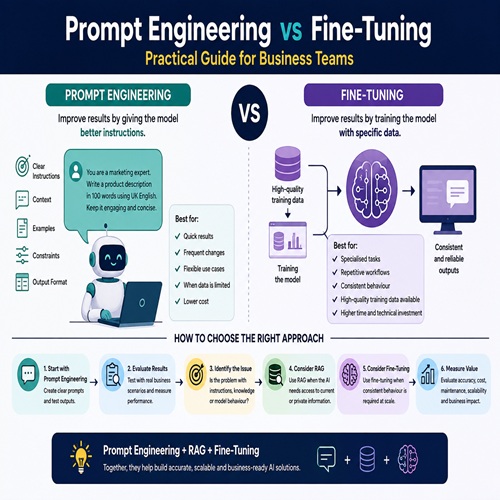
Prompt engineering is the process of creating specific and well-organized instructions to guide an AI model toward the result you want. Of changing the model itself teams improve the way they talk to it by giving it context, examples, rules, roles and how the answer should look.
For example a marketing group could ask an AI model to write product descriptions in a brand voice use British English keep each description under 100 words and include a certain keyword. These instructions can make the results more consistent without changing the model.
Prompt engineering is usually quick, easy to change and not very expensive. Teams can try prompts, see what works and make changes right away. Modern methods of engineering can include zero-shot prompting using a few examples, giving roles, setting output rules and breaking tasks into smaller steps.
The main difference is that prompt engineering changes the instructions while fine-tuning changes how the model works.
Prompt engineering is usually the place to start because it can be done quickly and changed whenever business needs change. It works well for content creation, summarizing, sorting taking data out customer service and other tasks where clearer instructions can make a difference.
Fine-tuning becomes more useful when the same kind of behaviour needs to happen over and over. It can help with writing styles, specific areas of knowledge, consistent sorting or tasks that happen a lot where just using prompts isn’t enough.
Businesses should usually start with engineering when they are trying a new AI idea or need quick improvements. It works well when the requirements change a lot or when users need to control the results in time.
For example a sales team might use prompts to create email drafts for different groups of customers. Since the instructions can be changed instantly prompt engineering gives the needed flexibility.
It is also an option when the company doesn’t have a big high-quality dataset to use for training.
Fine-tuning is worth thinking about when a business has a task, enough good examples and a real need for more consistent results.
Imagine a company that handles thousands of documents each month and needs the AI to sort them by internal rules. If carefully made prompts and examples still don’t give answers fine-tuning could be a better choice.
Fine-tuning shouldn’t be used just because a company has private information. If the problem is that the AI needs access to information that changes a lot or is private, retrieval-augmented generation (RAG) might be a choice. RAG lets the model get the information from outside sources without changing the model.
Teams can follow a plan before spending money on customising a model:
Start with prompting. Be clear about what needs to be done; give context and examples and set quality goals.
Check the results. Test the prompt with business situations, not just a few good examples.
Find the problem. If the model doesn’t have up-to-date or private information, think about RAG. If it still can’t behave the way it should even with good instructions and examples, look into fine-tuning.
Check the business case. Think about accuracy, how long it takes to make, how much it costs to keep running, how fast it works, what data is needed and the long-term costs.
Prompt engineering and fine-tuning don’t have to be rivals. In AI systems they work together. A tuned model can be consistent and prompts can give specific instructions and context. RAG can add up-to-date information when needed.
For business teams the best way is simple: start with prompt engineering, check how it works, and use RAG when the problem is about knowledge, and consider fine-tuning when consistency is still hard to get through prompting. This way companies can manage costs. Make sure AI investments are based on real business needs, not just technology.