
Predictive Analytics for Business: Examples, Models, and ROI

Introduction

The increasing use of social media and digital platforms has made it easier for businesses to collect a huge set of data from customer interactions, transactions, websites, IoT devices, and enterprise applications. The availability of this data helps businesses in understanding the things that have happened already, but considering future growth, businesses today are interested in knowing what will happen next. This is where the use of predictive analytics plays an interesting role. By analysing the available data with the help of statistical techniques, artificial intelligence (AI), and machine learning (ML), predictive analytics enables businesses to forecast future outcomes, reduce uncertainty, and make data-driven decisions with greater confidence.

What Is Predictive Analytics?

Predictive analytics is the process of comparing the available data with the current data to predict future trends or behaviours. This process of analysis is different from traditional business intelligence and does not focus on reporting past performance; instead, it helps organisations anticipate customer needs, market trends, operational risks, and business opportunities before they occur.

Modern predictive analytics techniques are powered by AI and machine learning algorithms that continuously learn from new data. This makes it easier for businesses to forecast the future with full accuracy. As a result, organisations can proactively respond to changing market conditions instead of reacting after problems arise.

Common Predictive Analytics Models

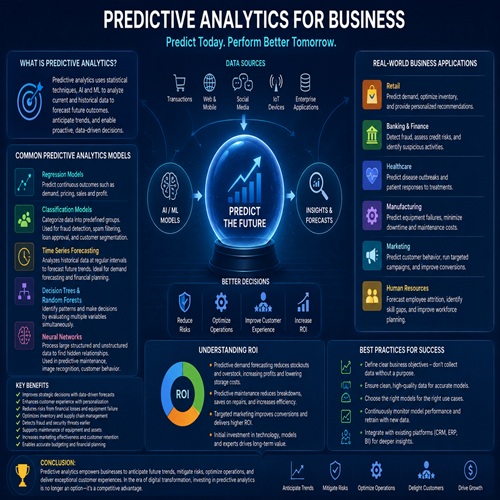
The use of predictive analytics models depends on the nature of a business, and therefore the same model cannot be implemented in all businesses. Some of the most widely used approaches include:

Real-World Business Applications

Predictive analytics is increasingly becoming an important business tool for numerous companies.

Retail companies:

For these organisations, these models are used to predict future demand, to optimise inventories and to provide personalised recommendations based on customers’ purchasing behaviour.

Banks and other financial institutions:

Predictive analytics models are used by these organisations to detect fraud, credit risks and other suspicious activities before any financial losses occur.

Healthcare companies:

The healthcare sector uses these models to predict disease outbreaks and patient responses to treatments.

Manufacturing companies:

The use of predictive analytics helps manufacturing companies to detect the failure of equipment in advance and minimise downtime and repair costs.

Marketing teams:

With predictive analytics, marketing teams can predict the buying behaviour of customers, conduct personalised marketing campaigns, and improve lead conversion rates.

Going through the benefits of initiating predictive analytics, human resource departments are using this technique to forecast the annual income of all employees, identify skill gaps, and improve workforce planning.

Benefits for Businesses

Predictive analytics has proved to be a beneficial tool for all businesses:

  • Helps in improving strategic decisions based on forecasts made on the basis of available data.
  • Enhances customer experiences by suggesting personalised recommendations based on their buying behaviour.
  • Reduces the risks associated with financial losses and equipment failure.
  • Optimises inventory and supply chain management.
  • Detects fraud and security threats earlier.
  • Supports maintenance of equipment and assets.
  • Increases marketing effectiveness and customer retention.
  • Enables more accurate budgeting and financial planning.

Understanding ROI

One of the main benefits of using predictive analytics is its ability to provide businesses with a definite return on investment (ROI).

In the case of an online business that makes use of predictive demand forecasting, the firm would be able to protect itself from the risks of shortages and excessive inventory, which would mean higher profits and lower storage costs. Predictive maintenance in manufacturing protects businesses from equipment breakdowns, which leads to savings on maintenance and increased efficiency.

Another area where companies benefit from predictive analytics is marketing, where businesses get high ROI by focusing on converting customers.

Of course, implementation of the technology will require costs in terms of infrastructure development, models, and experts.

Best Practices for Successful Implementation

Prior to implementing predictive analytics within their operations, businesses need to know why they want to introduce this process rather than focusing on collecting a large amount of data. Clean and high-quality data is needed to create predictive models. Further, businesses need to select the models depending on how they can be applied and to constantly keep an eye on model performance while training algorithms regularly when more data appears.

The combination of predictive analytics with the existing platforms such as CRM, ERP, and business intelligence provides additional insights for making better decisions.

Conclusion

Predictive analytics is revolutionising the process of making decisions in businesses. Thanks to AI, machine learning, and statistical methods, businesses can predict future trends, provide better customer experiences, mitigate risks and optimise operations. From predicting sales, minimising fraud to anticipating equipment failures, businesses can now make decisions without any delays. With digital transformation taking place now, it is expected that investing in predictive analytics will be a major trend for businesses.