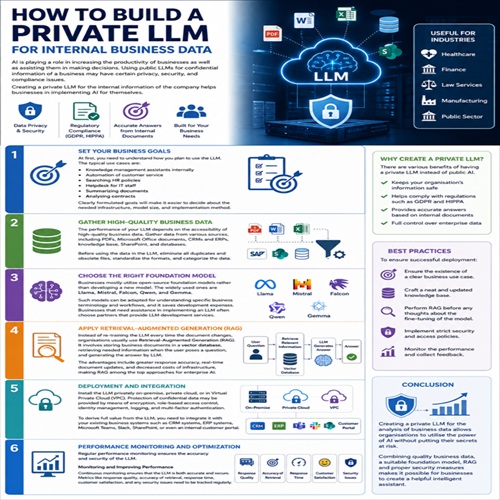
Set Your Business Goals
Gather High-Quality Business Data
Choose the Right Foundation Model
Apply Retrieval-Augmented Generation (RAG)
Deployment and Integration
Monitoring and Improving Performance
Set Your Business Goals
At first, you need to understand how you plan to use the LLM. The typical use cases are:
• Knowledge management assistants internally
• Automation of customer service
• Searching HR policies
• Helpdesk for IT staff
• Summarising documents
• Analysing contracts
Clearly formulated goals will make it easier to decide about the needed infrastructure, model size, and implementation method.
Gather High-Quality Business Data
The performance of your LLM depends on the accessibility of high-quality business data. Gather data from various sources, including PDFs, Microsoft Office documents, CRMs and ERPs, knowledge bases, SharePoint, and databases.
Before using the data in the LLM, eliminate all duplicates and obsolete files, standardise the formats, and categorise the data.
Choose the Right Foundation Model
Businesses mostly utilise open-source foundation models rather than developing a new model. The widely used ones are Llama, Mistral, Falcon, Qwen, and Gemma. Such models can be adapted for understanding specific business terminology and workflows, and it saves development expenses. Businesses that need assistance in implementing an LLM often choose partners that provide LLM development services.
Apply Retrieval-Augmented Generation (RAG)
Instead of retraining the LLM every time the document changes, organisations usually use Retrieval-Augmented Generation (RAG). It involves storing business documents in a vector database, retrieving needed information when the user poses a question, and generating the answer with an LLM.
The advantages include greater response accuracy, real-time document updates, and decreased costs of infrastructure, making RAG among the top approaches for enterprise AI.
Deployment and Integration
Install the LLM privately on-premises, on a private cloud, or in a virtual private cloud (VPC). Protection of confidential data may be provided by means of encryption, role-based access control, identity management, logging, and multi-factor authentication.
To derive full value from the LLM, you need to integrate it with your existing business systems such as CRM systems, ERP systems, Microsoft Teams, Slack, SharePoint, or even an internal customer portal.
Monitoring and Improving Performance
Continuous monitoring ensures that the LLM is both accurate and secure. Metrics like response quality, accuracy of retrieval, response time, customer satisfaction, and any security issues need to be tracked regularly.