
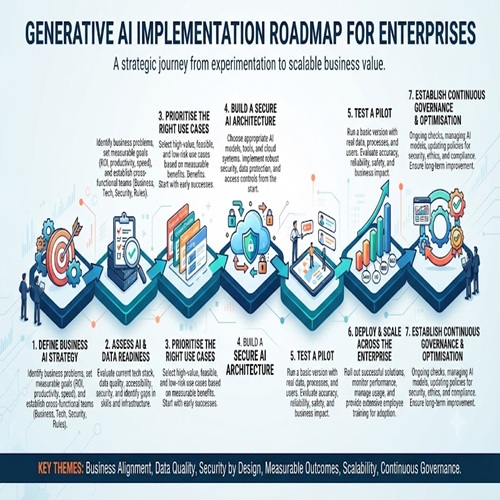
Generative AI Implementation Roadmap for Enterprises

Introduction

Generative AI is no longer a technique that businesses need to try before implementing it in their operations; on the contrary, it has become an integral part of their activities. Today, businesses are deploying generative AI to manage repetitive tasks, enhance customer experience, write content, and provide necessary information for better decision-making.  Getting generative AI to work well is not just about picking an AI model or starting a chatbot. Companies need a plan that links AI projects with what the company wants to achieve, the data they have, security, rules and results that can be measured.

A good plan helps companies go from tests to AI solutions that are dependable, can grow and are managed properly.

1. Define 'business'. Ai Strategy

The first step is to figure out why the company wants to use AI. Companies should find problems that AI can solve instead of just using technology because it is popular.

Goals might be to cut costs, make workers more productive, make customer service faster or create new digital products. Every goal should have things that can be measured so that the value of AI can be seen.

People in charge are also important at this point. The business, tech, security and rules teams should agree on what’s important, who does what and what is expected to happen.

2. Assess AI and Data Readiness

Before implementing an AI solution, companies should check if their current tech and data systems can support it. The quality, how easy it is to get, security and rules about data are very important because generative AI needs data from the company.

Companies should find where the data comes from, identify duplicate data, fix any problems with the data and make sure people can only get the data they need. Old systems and tools should be checked to see if there are problems with connecting or growing.

3. Prioritise the Right Use Cases

Not every part of a company needs AI. Companies should make a list of situations and look at them based on how much value they bring, how easy it is to do how much data is there, how hard it is to do and how risky it is.

For example, internal help tools, customer service help, summaries of documents, creating marketing content and helping with software development can be good places to start.

The best situations usually solve a problem and have benefits that can be seen. Choosing a few situations also makes it easier to show early success.

4. Build a Secure AI Architecture

Once the situations are chosen, companies need to decide what setup they need. This includes picking the models, AI tools, places to keep data, ways to connect, cloud systems and how to put it all together.

Security should be part of the setup from the start. Private information should be protected with ways to control who can see it, encryption, stopping data from being lost and ways to keep privacy. Companies should also make sure that AI tools only get the information that users are allowed to see.

5. Test a Pilot

The next step is to make a test or a basic version of the idea. The test should use business data, real work processes and real users instead of just being done in a quiet place.

Companies should check things like how good the answers are, how accurate, reliable and safe they are, and safe they are, how easy they are to use, how fast they are and how much they cost. People should still be involved when AI answers could affect business choices.

If the test meets the goals that were set, the company can move on to using it for real.

6. Deploy and Scale Across the Enterprise

Moving from a test to using it in real life needs more planning for the work and how to manage it. Companies need to watch what is happening, manage how well it works, control who uses it, have support and know who is in charge.

Training people is just as important. People need to know how to use AI tools, how to check the information AI gives, and how to handle data. Helping people change can make them use AI as a tool to work better or see it as taking their jobs.

Good solutions can then be used in parts of the company and in more ways of working.

7. Establish Continuous Governance and Optimisation

Using AI does not stop once it is put into use. The models, data, rules, costs and what the company wants keep changing. Companies need to keep checking and managing AI.

AI rules should handle privacy, security, following rules, being open, taking responsibility for how well the models work and using AI in a responsible way. Regular checks and ways to get feedback can help find problems and make AI better over time. 

AWS also says that moving from thinking about ideas and trying things out to putting them into action and making them work for the whole company needs rules, security and ways to manage it.

Conclusion

A good plan for using AI is not just about putting technology into place. It brings together the business plan, data, the way the system is set up, security, people and rules. Companies that start with goals, pick real situations, check them with tests, and have strict rules can build a better base for expanding AI.

As generative AI gets better, companies that see using it as a long-term change, rather than just trying a few things, will be ready to get real benefits from it.