
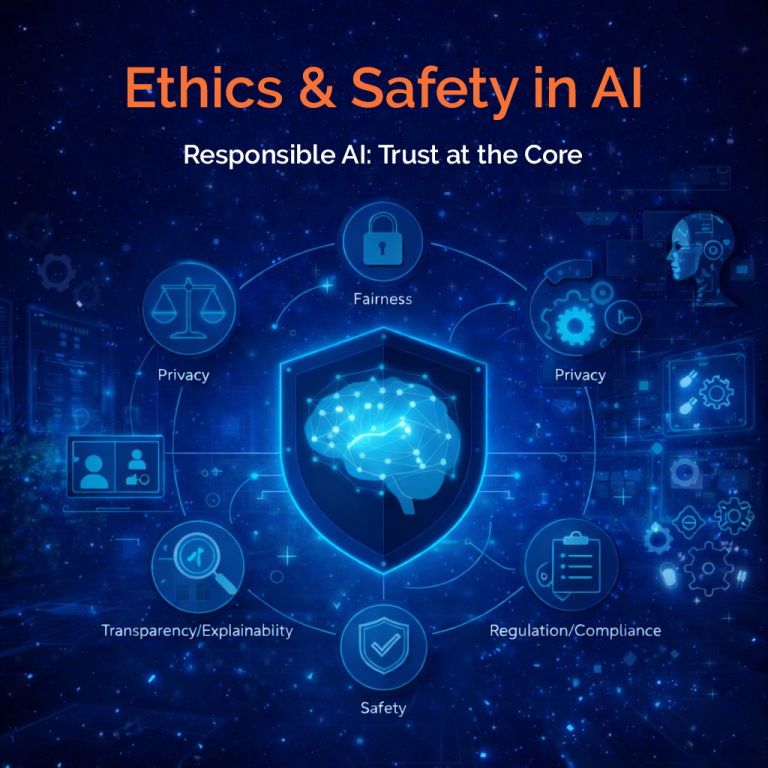
Ethics & Safety in AI

Introduction

The way we view and utilize AI has changed dramatically over the past decade. Today, AI is being integrated into virtually every aspect of life, including business, health care, family life, transportation, and many others. AI has revolutionized the way we make decisions and engage with customers, even if we do not realize it. From increasing the use of automated decision-making systems (e.g., forecasting future consumption) and personalized products and services to generative AI and predictive analytics, the growing power of AI technologies will continue to make decisions about how we create, consume, and use information.

Yet, as the use of AI grows, several concerns about ethical and safety issues have arisen. These concerns relate to algorithmic bias, unfairness, data privacy issues, the potential for AI to be used irresponsibly, and the lack of regulation surrounding AI technology. Meeting and resolving these concerns are necessary for AI to continue to be widely trusted, embraced, used, and helpful to society.

AI Misuse: Deepfakes and Misinformation

One of the most pressing safety concerns is the intentional misuse of AI technologies.

Examples of AI Misuse:

1. Deepfake Videos and Audio Used for Fraud or Harassment
  • Creation of realistic fake videos to impersonate individuals or executives
  • Voice cloning used for financial fraud, such as fake approval calls
  • Non-consensual deepfake content causing emotional and reputational damage
  • Increased difficulty in verifying the authenticity of digital media
2. AI-Generated Misinformation and Fake News
  • Rapid generation of misleading articles, images, and videos
  • Large-scale automated content distribution across social platforms
  • Manipulation of narratives during elections or public crises
  • Erosion of trust in credible news and information sources
3. Identity Impersonation Using Synthetic Voices or Images
  • Cloning voices to bypass authentication systems
  • Fake profile creation using AI-generated faces
  • Impersonation of public figures, employees, or customers
  • Increased social engineering and phishing attacks
4. Automated Manipulation of Public Opinion
  • AI-driven bots amplifying specific political or social messages
  • Targeted misinformation campaigns using behavioral data
  • Suppression or distortion of opposing viewpoints
  • Undermining democratic processes and public discourse

Impact of AI Misuse:

  • Loss of trust in digital media
  • Threats to democratic institutions
  • Financial, reputational, and psychological harm
  • Increased difficulty in distinguishing authentic content

Addressing misuse requires both technical safeguards and ethical accountability.

Privacy and Data Protection

AI systems rely heavily on data, often including personal or sensitive information. This creates significant concerns around data privacy, consent, and security.

Key Privacy Risks:

  • Excessive or unnecessary data collection
  • Lack of transparency in data usage
  • Unauthorized data sharing or breaches
  • AI models unintentionally retaining sensitive information

Responsible Privacy Practices Include:

  • Clear user consent and data transparency
  • Data minimization and anonymization
  • Secure storage, encryption, and access controls
  • Compliance with data protection regulations such as GDPR

Without strong privacy safeguards, AI systems risk eroding user trust and violating fundamental rights.

Bias and Fairness in AI

The Need for AI Regulation

AI development is advancing faster than existing legal and regulatory frameworks. Without clear rules and accountability, the risk of harm increases significantly.

Why Regulation Is Essential:

  • To protect individuals from harmful or unfair AI decisions
  • To ensure transparency and accountability
  • To prevent misuse and unethical deployment
  • To build public confidence in AI technologies

Effective AI Regulation Should Focus On:

  • Transparency and explainability of AI systems
  • Clear responsibility and liability structures
  • Risk-based classification of AI applications
  • Protection of privacy and human rights
  • International cooperation and standards

Regulation should support innovation while ensuring AI is deployed responsibly and safely.

Why Choose Dotsquares

Dotsquares is committed to building AI solutions that are:

  • Fair and unbiased
  • Transparent and explainable
  • Secure and privacy-compliant
  • Resilient against misuse
  • Aligned with regulatory and ethical standards

By choosing Dotsquares, organizations don’t just adopt AI, they adopt responsible, trustworthy, and future-ready intelligence.

Conclusion

The future of AI depends not only on its technical capabilities, but on how responsibly it is designed and governed. Addressing bias, fairness, privacy, misuse, and regulation is critical to ensuring AI serves society in a safe and ethical manner.

By embedding ethics and safety into AI systems from the outset, organizations can build technologies that are not only powerful, but also trustworthy and sustainable.

Responsible AI is not optional, it is the foundation for long-term innovation and societal trust.