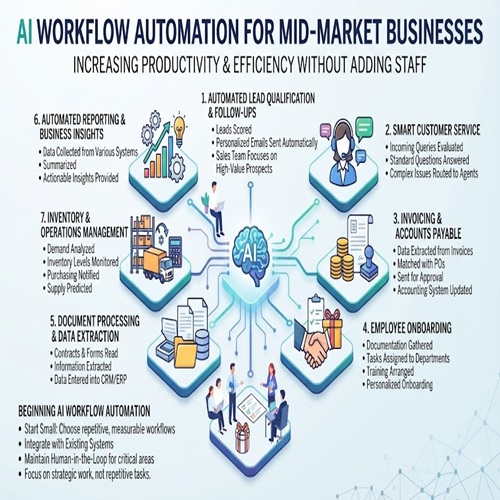
1. Automated Lead Qualification and Follow-Ups
To accomplish regular tasks, sales teams spend significant amounts of time processing leads by analysing them, finding the promising customers, and writing follow-up emails. Using AI, companies are able to process new leads based on a number of factors such as company details, lead activity, prior communication, etc.
An automated workflow can help companies collect leads from a website, email, or CRM systems; score them via AI, pass the leads to a sales representative; and create an automated personalised follow-up email. Thus, people can focus only on the valuable leads.
2. Smart Customer Service
The first step in customer service automation could involve using AI to evaluate incoming emails, messages or tickets, which includes assessing the intent of the client, urgency and extracting relevant information for routing to the appropriate department.
Standard questions can be answered automatically, while the rest are passed on to human agents along with a record of the discussion and customer information. Workflow automation of customer service processes is especially useful, as it involves both volume and repetitive decision-making.
3. Automated Invoicing and Payments
Finance departments receive invoices in various formats, making it necessary to perform manual data entry. Using AI, the workflow could extract information about suppliers, invoice numbers, dates, taxes and amounts from the document.
Next, it could match the invoice with the purchase order, look for any discrepancies, send it for approval and update the accounting system.
4. Employee Onboarding
AI can be used by HR departments to automate the process of employee onboarding. The moment the new employee starts working, the automated workflow will gather the necessary documentation, assign tasks for relevant departments, arrange training and answer frequently asked questions.
At the same time, AI will allow the onboarding information to be personalised based on the employee’s position and department, while workflow automation will make sure that all the critical steps are being done on time.
5. Document Processing and Data Extraction
Contracts, purchase orders, applications, compliance documents and many more documents are constantly used by mid-market organisations. With AI document processing, it will become possible to read these files, extract needed information and put it into CRM, ERP and other business applications.
It will save employees from entering data manually, as well as allow them to easily find and use any information. Document processing is one of the most practical starting points for mid-market AI automation.
6. Automated Reporting and Business Insights
The process of creating weekly and monthly reports may involve the need for collecting data from various systems and summarising them. The process could be automated using AI.
A workflow can be designed to extract data from the company’s CRM, finance, sales, and other operational platforms, analyse any important changes and provide business summaries. In addition, instead of providing mere statistics, AI can provide insights about the changes that occurred and things that should be taken into account.
7. Inventory and Operations Management
Using AI, organisations can be able to control inventory, analyse demand and anticipate any problems regarding supply. When the inventory level reaches the defined limit, the workflow will notify the purchasing department of the company about it or take the next step in the approval process.
For companies with a complicated supply chain, AI can be used for analysing historical and present data and making predictions regarding demand and operations.