
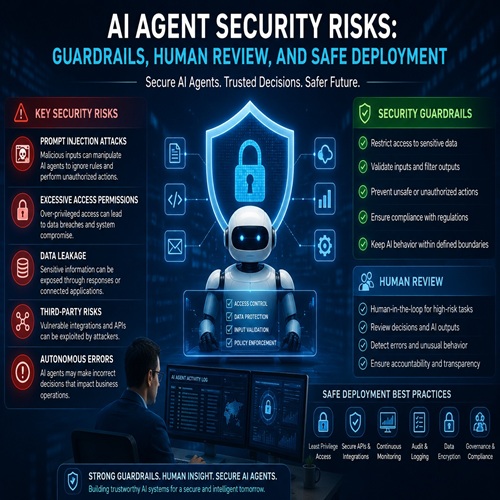
AI Agent Security Risks: Guardrails, Human Review, and Safe Deployment

Introduction

The AI agents have changed the way business processes function by automating workflows, analysis of data, and integration with enterprise applications without much human intervention. While traditional AI models work in reaction to inputs, AI agents are able to plan tasks, make decisions, and communicate with other software applications. However, while these features are useful for increasing efficiency and effectiveness, they also suffer from lot of security threats. Without proper security, AI agents may be exposed to data leaks, unauthorised activity, or even cyber attacks. Thus, it is essential that companies using AI Agent Development Services think of security from the very beginning.

Understanding the Security Risks of AI Agents

As AI agents gain access to enterprise applications, databases, APIs, and cloud services, they become appealing targets for cybercriminals. Among the most popular security threats are:
Prompt Injection Attacks
Prompt injection happens when attackers exploit AI agent using hidden malicious commands contained in user inputs, documents, or web content in order to trick the system into ignoring its instructions and disclosing sensitive information.
Excessive Access Rights
As AI agents need access to business systems to complete tasks, providing them with unlimited rights can pose a threat of data breaches in case of any security incident. Least privilege policy can help prevent this from happening.
Data Leakage
AI agents work with confidential client data, financial information, and other important data that is used by businesses. Weak security measures can result in leaking the information.
Third-Party Integration Threats
Most of the AI agents use APIs and other external services. If any of the third-party services turns out to be vulnerable, attackers will be able to abuse it to infiltrate the AI environment.

Why AI Guardrails Are Essential

‘Guardrails’ for AI refer to pre-set rules and technical safeguards to direct the behaviour of the AI agent.
Functions of AI Guardrails
Limiting access to confidential company data
Halting any unauthorised or dangerous actions by the AI
Capturing and verifying inputs from users
Blocking inappropriate or non-compliant outputs
Supporting adherence to security and privacy policies
Companies looking to implement Generative AI Solutions must develop guardrails to prevent security threats but at the same time preserve AI performance.

The Significance of Human Review

Despite the many innovations within the field of artificial intelligence, the human factor cannot be underestimated where financial considerations, legal paperwork, health concerns, consumer grievances, and security matters are at stake.
Benefits of Human Involvement
Enables error detection before the application of AI
Enhances accountability and transparency
Ensures compliance with organisational rules
Lowers the risk of any possible issues
Creates trust among customers

Best Practices for Safe AI Agent Deployment

An AI implementation must have different levels of security.
Principle of Least Privilege: Assign AI agents with the minimum level of privileges they need for performing their particular activities.

Protect API Integration: Use authentication, encryption, and access control to secure the connection between different programs with regular security checks.

Monitor AI Activities: Create logs for the activity performed by users, their command execution, and access to the data.

Input/Output Validation: Inspect input commands for any harmful components and output of the data that violates any policy.

Encrypt Data: Make sure that the data is always encrypted.

Establishing an AI Governance Framework for Security Purposes

Security is not enough on its own. The organisation needs to have a strong AI governance policy that covers security and many other aspects such as monitoring, risk management, training staff and incident response planning. Cooperation with experienced AI consulting services will help establish a solid framework for implementing AI securely.

Conclusion

With increasingly independent AI agents, security must remain a key consideration. The integration of intelligent guardrails, human review, real-time monitoring, and governance allows organisations to leverage AI effectively by limiting any cybersecurity or operational threats. Companies using enterprise AI solutions need to include security at every step of AI development.