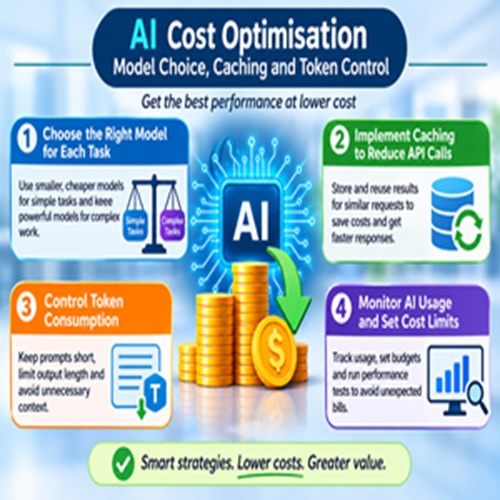
AI Cost Optimisation: Model Choice, Caching and Token Control

Introduction

Generative AI is changing the way companies work, automate tasks and connect with customers. As more businesses use AI-powered tools, the cost of running large language models has become a big concern. Frequent API calls, long prompts, repeated questions and priced models can quickly add up.

Cost Optimisation for Generative AI means keeping expenses low without hurting performance, response quality or the user experience. This can be done through three methods: choosing the right AI model using caching effectively and managing token use.

1. Choose the AI Model for Each Task

One of the best ways to save money on Generative AI is to pick the right model for each job. Many companies use expensive models for every request—even when a simpler model would work just fine.

For example, simple tasks like text classification, extracting keywords, summarising content or answering questions can often be handled by smaller, cheaper models. Save the models for complex work—like technical analysis, deep reasoning or situations where high accuracy is required.

Another smart way is model routing. This automatically sends requests to the suitable model based on how complex the task is. For questions, a smaller model does the job. For others a more powerful model steps in.

This helps companies keep quality high while avoiding spending on top-tier models.

2. Implement Caching to Reduce Repeated API Calls

Caching is a way to cut down on AI costs. Many AI apps get  very similar requests over and over. Each time the model processes the input, it uses resources and increases costs.

With caching, the system stores results and uses them again when needed. This avoids redoing the work, reduces API calls and speeds up responses.

There are several types of caching to consider:

– Prompt Caching: Stores parts of the prompt that are used often—like system instructions or background context. This keeps the cost of processing repeated input tokens down.

– Semantic Caching: Recognises questions that have the same meaning and pulls an old response instead of making a new model call.

– Response Caching: Saves answers to questions—like product details, FAQs or standard customer support replies.

Caching must be done carefully. Never reuse responses that include data, current prices or other real-time information without checking first. Use expiration times for data to stay accurate.

3. Control Token Consumption

Tokens are the units of text that generative AI models process. Most services charge based on the number of input and output tokens used. So using many tokens can drive up costs—especially in apps with high traffic.

To reduce the use, make prompts shorter, clearer and more focused. Adding background details, repeated instructions or full conversation history increases input tokens unnecessarily.

Here are some practical steps to control use:

– Optimise Prompts: Be direct. Use instructions and avoid extra words or repeated content.

– Limit Output Length: Set maximum response lengths so the model doesn’t generate long answers when short ones are enough.

– Manage Conversation History: Keep only relevant parts and replace long chat histories with short summaries.

– Reduce Unnecessary Context: Only give the documents, data and info needed for the task.

– Monitor Token Usage: Track input and output tokens to see which requests cost the most and find ways to improve them.

These steps help keep AI spending under control while still delivering relevant responses.

4. Monitor AI Usage and Set Cost Limits

Cost Optimisation should not be a one-time fix. It should be an effort. Companies need to keep an eye on API usage, model performance, average token costs and application behaviour through reports.

Setting usage limits, budget alerts, and request thresholds helps stop charges. For tasks that don’t need to be done immediately, use batch processing if possible. This can often be cheaper than processing everything in time.

Performance testing is also important. Any cost-saving change should be checked against response accuracy, speed and how well users respond.

Conclusion

Generative AI cost Optimisation is essential for companies planning to grow their AI applications without increasing costs. Choosing the model, using caching and controlling token usage can make a big difference in cost efficiency.

By combining these strategies with monitoring and performance checks, organisations can build AI solutions that are scalable, reliable and cost-effective. They can still deliver high-quality AI services without overspending.