
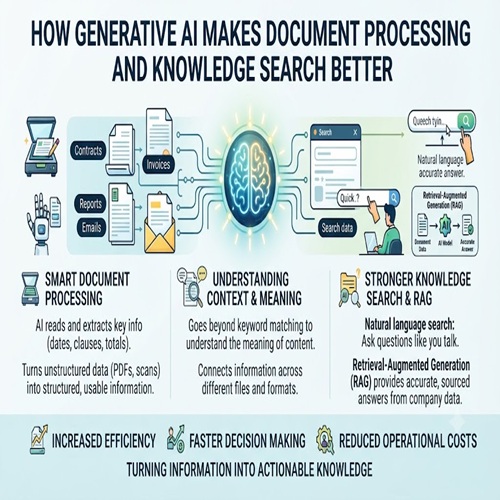
How Generative AI Makes Document Processing and Knowledge Search Better

Introduction

Companies deal with a lot of information every day. Contracts, invoices, reports, emails, rules, presentations and customer files have details but finding and working with that information can take a long time. Old ways of managing documents often rely on people doing the work and looking for words, which makes it hard for workers to get the information they need quickly.

Generative AI is making document processing and knowledge search better by helping companies understand, sort and get information in a way. Of just keeping documents, AI can turn messy business information into something that is easy to use and find.

Smart Document Processing

Old ways of processing documents usually mean people reading them taking out info and putting it into company systems. This can take a lot of time. Sometimes leads to mistakes.

Generative AI can handle many of these tasks. It can look at documents find details make summaries and take out key data from different types of files. For example AI can check contracts. Find dates when they need to be renewed payment rules things the company has to do and important parts of the agreement.

This means workers spend time looking at documents and more time doing work that needs their thinking.

Better Understanding of Unstructured Data

One big benefit of AI is that it can understand what information means not just look for individual words.

Business data is often in formats that are not organised, like PDFs, emails, reports and slides. AI can look at these. Find how different pieces of info are connected.

For instance, someone looking for details about a company’s working-from-home rules might use language instead of a specific word. AI can understand what the person is trying to find and find the info even if the documents use different words.

Stronger Knowledge Search

Old search systems usually depend on matching words. This can lead to results that are not useful if the search doesn’t use the same words as the documents.

Generative AI can make knowledge search better using picture-based search. These methods look at the meaning and situation of the info so people can find what they need even if different words are used.

AI-powered search can make big company information libraries easier to use. Workers can ask questions in language and get the right info without opening many files.

Retrieval-Augmented Generation (RAG) is a key technology for creating AI-based search systems. RAG finds info from a companys knowledge sources and gives that info to a generative AI model as background before it answers.

This helps companies link AI models with their files and knowledge collections. It can also lower the chance of AI making up info because answers are based on real business data.

RAG is especially helpful for helpers, customer support, legal file checks and big company search tools.

Making Business Efficient

Generative AI can cut down the time workers spend looking for info and doing repetitive tasks with documents.

For example HR teams can quickly find company rules finance teams can get info from bills and reports. Legal teams can check contracts and find important parts. AI can also make versions of long documents compare info between files and give clear answers to worker questions.

This can make work faster. Let teams focus on thinking making decisions and other important tasks.

Creating an AI-Driven Knowledge System

Generative AI is changing documents, from sources into active knowledge tools. By using document processing, smart search, picture databases and RAG companies can build systems that understand their info and make it easier to find.

As companies keep making digital content AI-based document processing and knowledge search can become a big part of company digital changes. Companies that use these tools can cut down on work make info easier to get and create smoother knowledge-based work.

With the AI setup, security measures and solid business data companies can turn their growing file collections into a useful source of action-ready knowledge.