
RAG vs Fine-Tuning: Best Approach for Enterprise Knowledge Assistants

Introduction

The use of enterprise knowledge assistants has increased highly by employees for accessing required information, answering queries, summarising documents, assisting customers and enhancing access to organisational knowledge. However, for businesses to leverage knowledge assistants properly, the appropriate architecture must be applied in order for these AI assistants to be useful and efficient. Retrieval-Augmented Generation (RAG) and fine-tuning are two common architectures, but each plays a specific role. Learning the differences between them would enable enterprises to select the right technology for their AI knowledge assistants.

What Is RAG?

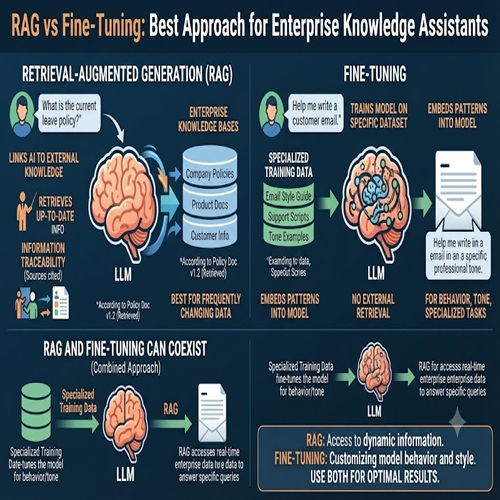
The Retrieval-Augmented Generation (RAG) links a generative AI model to external knowledge bases. In case there is any query posed by the user, the system looks for relevant enterprise data, retrieves the needed information and gives it to the AI model for the generation process to follow.

For instance, if an employee asks about the current leave policy, instead of the model using its knowledge base, which was developed through pre-training, the RAG system can retrieve the most recent document regarding the leave policy and then use it to create an answer to the query.

This feature makes RAG especially useful for companies where there is constant updating of information. Examples include company policies, product information, technical documents, customer information and regulatory requirements, among others.

What Is Fine-Tuning?

Fine-tuning involves the training of an existing pre-trained AI model using a certain dataset for the same. This is aimed at tailoring the AI model to suit a certain task, domain, communication, or response.

For instance, in an organisation, one may fine-tune an AI model to communicate in a certain voice, identify customer service inquiries, or give certain kinds of responses. It follows that fine-tuning improves the performance of an AI model in its specialised task.

Nevertheless, fine-tuning is not necessarily the most effective method of supplying an AI assistant with dynamic information from enterprises. This is because any changes in company policies or products mean that the AI model must be fine-tuned again.

RAG versus Fine-Tuning: The Main Difference

  1. The main difference between the two techniques is in the location of the enterprise’s knowledge and the way the AI accesses that knowledge. In RAG, enterprise information is stored in external databases, and the information that is relevant to a user request is retrieved by the AI. On the other hand, fine-tuning includes embedding patterns from the training dataset into the model.
  2. Hence, in most cases, RAG will be more beneficial when the enterprise wants to make the assistant work with updated and frequently changing information. In this case, the enterprise does not need to train its AI again when the information has been updated.
  3. However, if the enterprise wants to affect the style of the model’s operation, its behavior or some specialised capabilities, fine-tuning can be used for this purpose. However, the training data must be properly selected and prepared for this task.
  4. The other difference is information traceability. Through RAG, it is possible to retrieve specific documentation and passages that are used to provide answers. Depending on how the technology is used, these sources may be made available to users for them to learn the origin of the answer. On the other hand, fine-tuning does not have this retrieval feature.

Which Is Better for Enterprise Knowledge Assistants?

In most cases, enterprise knowledge assistants require access to different business documents such as policies, product details, manuals, databases, and many more. These sources of information change with time.

With RAG, it is possible for organisations to connect these sources of business knowledge to an AI knowledge assistant. RAG also helps organisations avoid situations where the answer is provided based only on the model knowledge, which could be outdated.

Fine-tuning comes into play when there is a need to create a certain behaviour or task for the AI knowledge assistant. For example, a customer service company could fine-tune its assistant to respond in a certain communication style.

Is It Possible for RAG and Fine-Tuning to Coexist?

An answer to this question in a single word is “YES”. The enterprise does not have to opt for one option and exclude the other. They can coexist.

An organisation may fine-tune a model to make it better at performing certain functions or to adjust its communication style, and then use RAG to ensure access to relevant up-to-date enterprise information. The two combined will produce an AI assistant that knows how to communicate and has access to information that it needs to answer.

Conclusion

Both RAG and fine-tuning solve different AI enterprise problems. While RAG aims to ensure that models are provided with relevant up-to-date organisation-specific information, fine-tuning aims to ensure that a model can be trained to behave in a certain way.

For a knowledge assistant that has to respond to queries using regularly updated information, it is usually more feasible to use RAG. Fine-tuning can then be employed when further model customisation is needed.