
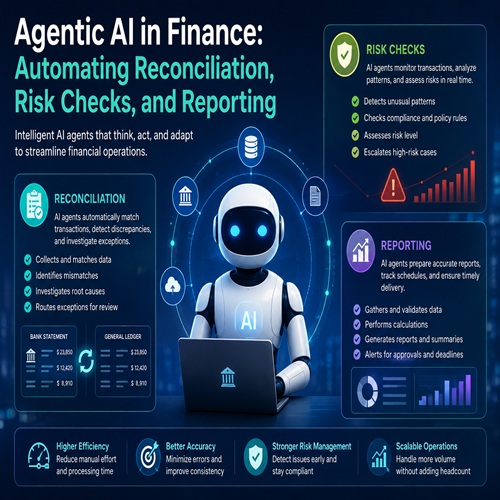
Agentic AI in Finance: Automating Reconciliation, Risk Checks, and Reporting

Introduction

Like any other business, artificial intelligence technology has also invaded the financial sector and has become a key tool to improve efficiency, effectiveness, and decision-making processes. The most recent update of artificial intelligence in the financial sector has been the advent of agentic artificial intelligence. Agentic AI in the finance sector has proved to be an extremely useful tool to automate the financial process that involves many steps. In contrast to the traditional systems of AI, which work on one prompt or task at a time, agentic AI can think ahead, use various sources of information, analyse data and execute processes with minimal human interference.

What Is Agentic AI in Finance?

Agentic AI means those AI systems that work as agents. When talking about finance, these agents can gather data from banking systems, accounting systems, transactional databases, and other external sources. Furthermore, the AI system can analyse the data, identify exceptions, and take proper action.

An example of this would be where an AI agent is looking at transactions and identifies some difference between the bank statement and the ledger account. The exception is investigated further, and the supporting data is collected by the AI agent.

Automating Financial Reconciliation

Efficiency will also arise from the implementation of agentic AI in reconciliation processes. There may be cases where financial analysts must reconcile transactions between bank statements, payment systems, accounting software, and internal books. In such instances, manual reconciliation could take up time, especially for organisations handling large volumes of transactions.

Agentic AI can help in retrieving transaction information, matching the relevant records, finding differences, and categorising the exceptions. The agentic AI can look into the common reasons why there may be any discrepancies, such as duplicate transactions, lack of transaction details, erroneous amounts, and others. With agentic AI, financial analysts will have to deal with exceptions only and not all transactions.

Smarter Risk Checks

Risk management involves the process of analysing transactions, customers, finances and operations on a continuous basis. Conventional rule-based systems will be able to recognise pre-existing risk patterns but might find it difficult to handle risk patterns involving complex combinations or changing environments.

Agentic AIs can use transaction information, customer information, pattern information, business rules, and risk indicators to conduct a contextual analysis of each case. A smart AI system will analyse any odd transaction activity, study relevant documentation, analyse risks and take appropriate action based on existing policies.

Hence, agentic AIs can be used effectively to prioritise cases that need further attention by risk officers.

Automating Financial Reporting

Financial reporting requires gathering information from different systems, verifying information, making calculations, and providing the result in a structured way. An agentic AI could greatly help with such processes.

An AI agent could get financial information, find missing or conflicting information, make pre-defined calculations, create a summary of the process, and draft a report. It could also track reporting deadlines and notify people in charge about the need for information or approval.

With the proper system in place, this could speed up the reporting process significantly.

Benefits for Financial Organisations

There are various benefits of adopting Agentic AI in the finance sector. Some major benefits include efficiency in operations, faster processing, better exception handling, and a reduced workload. Monitoring can be done continuously, helping firms spot anomalies before there could be any risk.

Scalability is yet another benefit of adopting Agentic AI. With an increasing number of transactions, AI agents are capable of handling large volumes of structured as well as unstructured data without having to increase the human workload.

Challenges and Considerations

However, agentic AI in finance holds a lot of promise; it requires robust governance mechanisms. Permissions, data security policies, audit trails, and human involvement should be ensured. The decisions made by AI must be explainable and auditable, particularly in case they concern customers, transactions, regulations, and financial reports.

It is essential to implement a managed approach in which AI agents will automate certain tasks while people will manage high-level decisions.

Agentic AI in Finance: Its Future

The technology of Agentic AI makes financial automation much more intelligent. As long as reasoning, data integration, monitoring, and taking actions become manageable, AI agents will help financial organisations in optimising their operations regarding reconciliation, risk-checking, and financial reporting.

Once the technologies and the governance models evolve, agentic AI can become an integral part of financial processes, which will make financial organisations operate faster and better manage risks, thus giving an opportunity to finance specialists to focus on something else.