
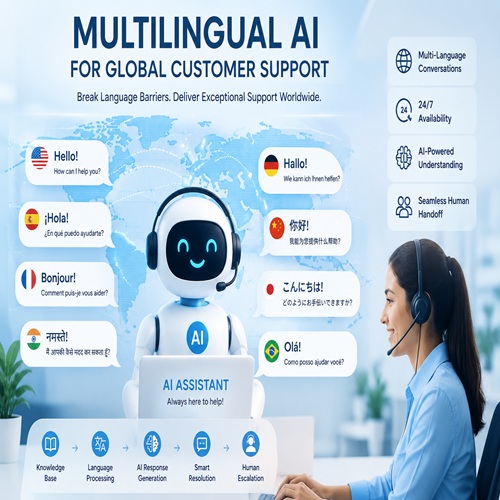
Multilingual AI for Global Customer Support

Introduction

Businesses have now transcended geography. Customers today need quick help from any business in their own language, whether it is through shopping on its website, using the company’s SaaS platform or getting technical help. This increased demand for help in different languages has made multilingual AI assistants an integral part of today’s customer service. With the combination of artificial intelligence, natural language processing and machine learning, a business can automate its customer services with multilinguality and personalized customer experiences.

Why Multilingual AI Assistants Are Important

Multilingual AI assistants come in handy for global businesses which have been struggling to provide 24/7 services in multiple languages. Having a team that speaks the language of each region is costly and not an easy task. Multilingual AI assistants have made this problem solving easier as they understand the query, translate the context and respond back in the desired language of the user.
Besides reducing costs, multilingual AI assistants improve the satisfaction level of customers with better response time without any language barriers.

Key Components of a Multilingual AI Assistant

Steps to Build Global Customer Support Automation

Businesses looking to build a global customer support automation should start their journey by:

Defining Business Objectives

Define your customer support objectives at first. You must consider what the AI assistant can be responsible for; whether it can answer your FAQs, track orders, troubleshoot any technical issues, make appointments, or provide full customer support services.

Select the Languages to Support

Consider customer demographics and the target markets when defining your list of supported languages. Prioritise the most important languages before considering the local dialects.

Centralised Knowledge Base for the AI Assistant

Your AI assistant should have access to an up-to-date knowledge base related to your products, policy statements, troubleshooting documents, and customer support documents.

Training of the AI Model

Use a multilingual dataset consisting of customer interaction records from diverse areas.

Integrate Business Systems

Connect the assistant with CRM platforms, ticketing software, ERP systems, payment gateways, and live chat tools. This enables the AI to retrieve customer information, create support tickets, and complete routine tasks automatically.

Add Human Escalation

Not every customer issue can be resolved automatically. Complex or sensitive queries should be seamlessly transferred to human agents along with the conversation history, reducing repetition and improving customer experience.

Advantages of Multilingual Customer Support Automation

Organisations that utilise multilingual AI agents can enjoy the following benefits:
• Offer customer support on a round-the-clock basis.
• Lower costs by automating customer support processes.
• Reduce the time taken for responding to customers and resolving their issues.
• Provide consistent quality of services across multiple languages.
• Converse with thousands of customers at once.
• Promote customer satisfaction and brand loyalty.
• Support growth of the business into international markets.

Challenges That Need Attention

Even with many developments that have been made, multilingual AI assistants do encounter some challenges. These include issues arising from regional dialects, slang, idiomatic phrases, and cultural differences, which can impact the translation process. Specialised industry terminology might also require retraining of models.
Another factor is the data privacy challenge. Companies must ensure compliance with regulations like the GDPR and other regional data protection laws while handling multilingual customer data.
Continuous monitoring, model retraining, and updating of the knowledge base ensure the accuracy of responses.

The Future of Global AI Customer Support

It is speculated that in the coming years, multilingual AI assistants will not only reply to customer queries, but they will also understand emotions, sentiment of customers, and cultural context to provide personalised service to each customer according to the history and preferences of the customer.

Generative AI combined with Retrieval-Augmented Generation (RAG) will also improve response accuracy by grounding answers in trusted business knowledge rather than relying solely on model training.

Conclusion

Multilingual AI assistants are revolutionising customer support around the world, allowing companies to interact with customers in their native languages on a large scale. Given the correct combination of AI models, knowledge management, integration, and supervision, companies can automate customer support while providing personalisation and cultural relevance. Multilingual customer support automation is set to be one of the defining features of the future as AI technology advances further.