
How to Build an AI Agent for Customer Support: Architecture, Cost, and Workflow

Introduction

The increasing use of artificial intelligence in customer support services has changed their expectations. Today, instead of waiting in a queue, customers expect instant responses, 24/7 availability, and personalised support through all social media platforms. Satisfying all these expectations of customers manually is almost impossible for any business; to combat this problem, businesses are shifting towards the introduction of AI-powered customer support solutions. 

The noticeable feature of an AI customer support agent is that it can automate routine interactions, reduce operational costs, and improve customer satisfaction without compromising the quality of service. Understanding the architecture, development workflow, and associated costs is essential before starting an AI agent project.

 An AI customer support agent is a sophisticated computer program designed to understand the customer’s query, gather pertinent information, and respond in natural language. As opposed to chatbots, which employ predefined scripts, these agents utilise Large Language Models (LLMs), machine learning, and enterprise data to respond to customers with the correct information.

The agents are able to:

  •       Respond to FAQs
  •       Check for order status and ticket status
  •       Provide recommendations for products
  •       Schedule appointments
  •       Process return and refund requests
  •       Escalate difficult issues to human representatives

The more the agents interact with customers, the better they get at what they do.

Architecture of an AI Customer Support Agent

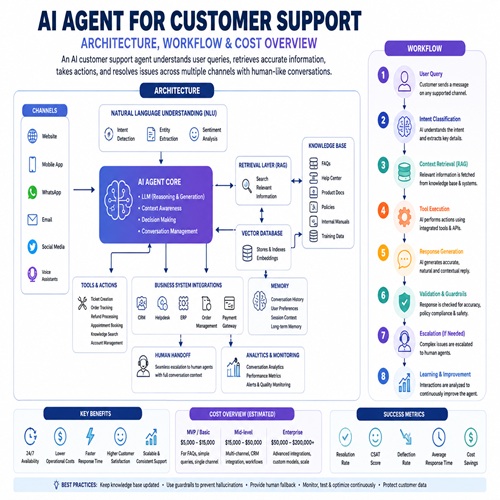
Creating an efficient AI support agent involves the following components.

1. User Interface

 Today, customers have multiple options to stay connected with businesses, including websites, mobile applications, WhatsApp, social media platforms, email, or voice assistants. The interface captures user requests and forwards them to the AI engine.

2. Natural Language Processing (NLP)

 The NLP layer understands the needs of a customer, collect all the important information, identifies sentiment, and understands conversational context. This enables the AI to communicate naturally instead of depending on keyword matching.

3. Large Language Model (LLM)

The LLM acts as the reasoning engine. LLMs can generate replies similar to human beings; they can summarise conversations, explain products, and assist customers in solving problems. Based on their working requirements, businesses can either use base models or install models that match their specific needs.
Depending on business requirements, organisations may use hosted foundation models or deploy fine-tuned private models.

4. Knowledge Base

An AI that is used for customer support functions better if it is integrated with business data, such as:

  •       Product documentation
  •       FAQs
  •       Help centre articles
  •       Internal support guides
  •       Company policies
  •       CRM data

Most businesses use Retrieval-Augmented Generation (RAG), which involves retrieving the right information before generating the response. This helps to enhance accuracy.

5. Business Integrations

The AI agents may be integrated with existing business systems, such as:

  •       CRM systems
  •       Helpdesk systems
  •       ERP systems
  •       Order management systems
  •       Payment gateways
  •       Inventory databases

Such integration helps the AI perform tasks rather than just responding to queries.

6. Analytics and Monitoring

Monitoring the performance of AI agents helps in tracking the quality of customer interaction, their satisfaction, response accuracy, escalation rates, and operational performance. Details collected from all these variants are useful in enhancing the performance of AI agents.

Development Workflow

Cost of Building an AI Customer Support Agent

Best Practices

To maximise ROI, organisations should:

 • Keep the knowledge base updated.
• Always provide an option to transfer customers to human agents.
• Monitor AI performance regularly.
• Protect customer data using strong security practices.
• Continuously retrain and optimise the system based on customer interactions.

Conclusion

Creating an AI customer service representative is not only about creating a chatbot for your website. An effective system requires a strong architecture, high-quality enterprise data, smart workflow management, and tight integration with your business. Although the cost of implementation depends on the complexity of the project, an AI agent can bring considerable savings, increase the speed of responses, and increase customer satisfaction. With the development of AI, those who implement it now will have a chance to offer more efficient and intelligent customer experiences in the future.