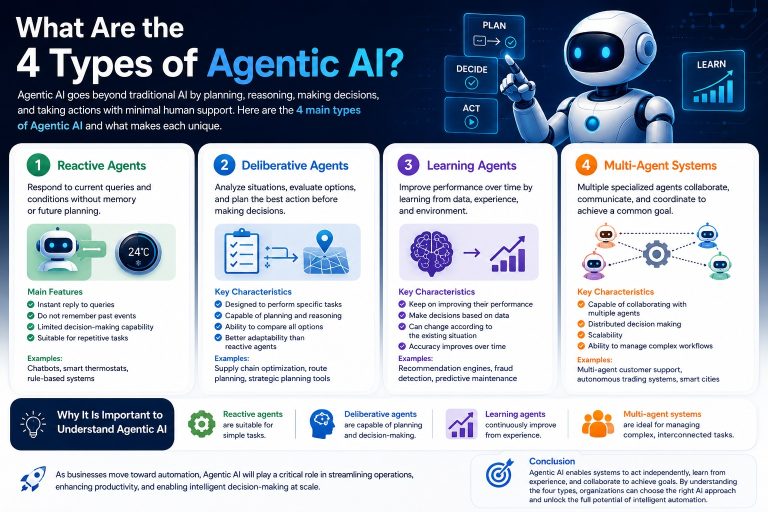
1. Reactive Agents
Reactive agents are simple systems which respond to existing queries and conditions without maintaining long-term memory or planning future actions. These agents work on predefined rules and immediate observations. For example, a chatbot installed to reply to customer queries is able to reply to them based on the available information. Another example can be a smart thermostat that adjusts room temperature according to current conditions.
Main Features:
- Instant reply to queries
- Do not remember past events
- Limited decision-making capability
- Suitable for repetitive tasks
These agents are efficient of performing simple tasks. They lack the power of from previous experiences or work according to changing situations.
2. Deliberative Agents
Deliberative agents can be regarded as an advanced version of reactive agents. They are capable of analyzing situations, comparing all the available options, and creating a plan of action before making decisions. These agents maintain an internal model of their environment and use reasoning mechanisms to determine the best possible action. They are commonly used in business for automating repetitive tasks, route optimization, and strategic planning applications.
Key Characteristics:
- These are designed to perform specific tasks for which they are developed * Capable of planning and reasoning
- Ability to compare all the available options
- Better adaptability than reactive agents
For instance, an agentic AI installed to manage the tasks of a supply chain will first analyze the availability of the whole inventory, supplier availability, and demand forecasts before recommending procurement decisions.
3. Learning Agents
Learning agents keep on enhancing their performance by analyzing past experiences and operating according to existing conditions. These agents are enriched with the power of machine learning techniques to refine their decision-making processes after a specific period of time. They are different from reactive and deliberative agents, and grow as they interact with users and environments.
Key Characteristics:
- Keep on improving their performance
- Make a decision based on the available data
- Can change according to the existing situation
- The accuracy of their service improves over time
Examples of learning agents are recommendation engines, fraud detection systems, and predictive maintenance platforms that become more effective as they process additional data. Organizations looking to deploy intelligent systems use specialized Agentic AI solutions that incorporate learning capabilities to improve efficiency and business outcomes.
4. Multi-Agent Systems
Multi-agent systems are a highly advanced version of Agentic AI. Instead of depending on a single intelligent agent, these systems consist of multiple specialized agents working together to achieve a common objective. Each agent is deployed to perform a specific task, communicate with other agents, share information, and coordinate actions to solve complex problems.
Key Characteristics:
- Capable of collaborating with multiple agents
- Distributed decision making
- Scalability
- Ability to manage complex workflows
A multi-agent customer support platform, for example, may use separate agents for query classification, knowledge retrieval, response generation, and escalation management. Together, these agents create a seamless customer experience.